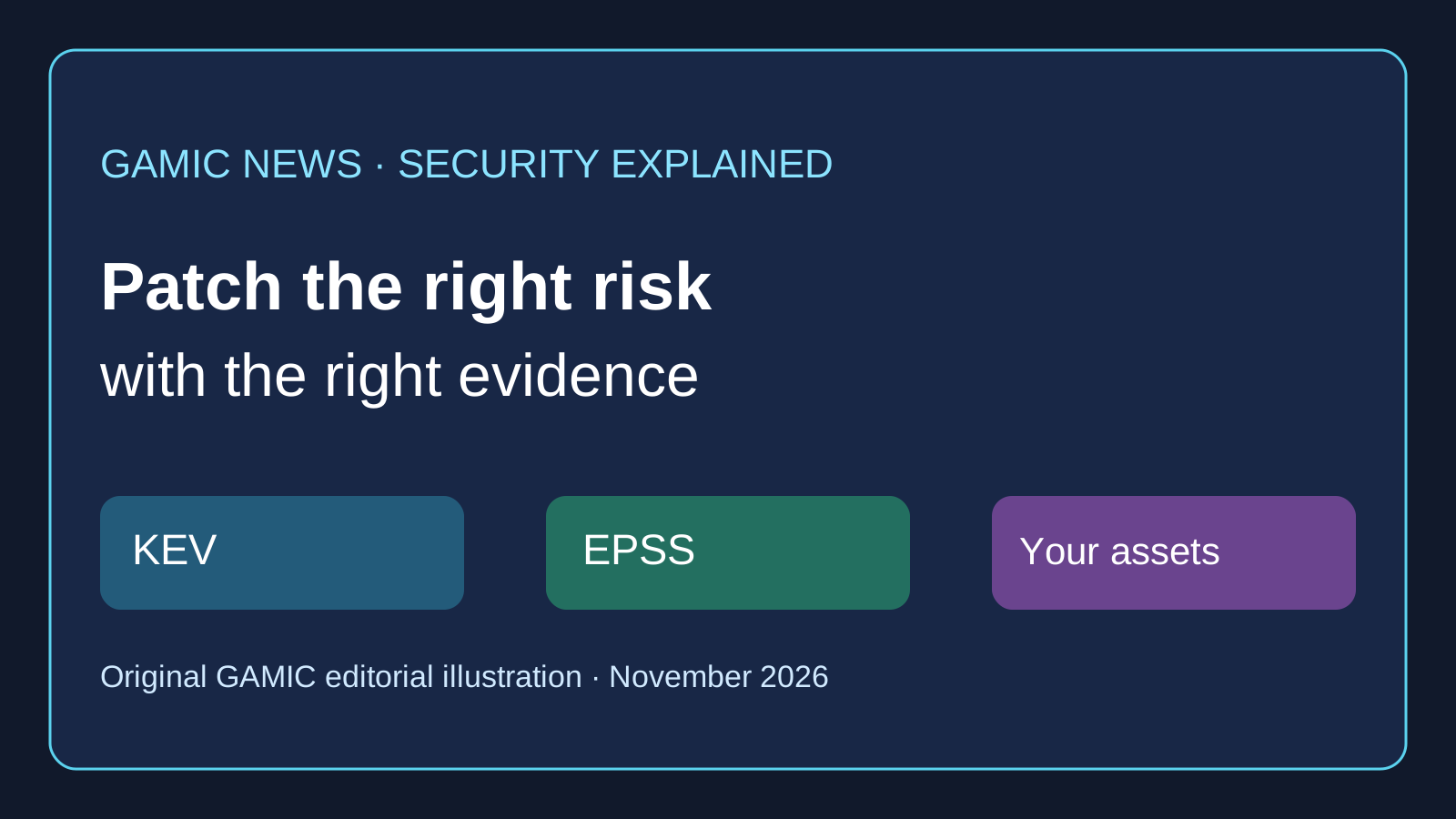
Quick answer: check whether the affected software actually exists, treat confirmed exploitation as a high-priority signal, use EPSS to compare still-uncertain cases, and verify that remediation reaches the real system. Neither a green automation log nor a severity score is a substitute for a tested fix.
Why vulnerability teams need more than a severity score
A vulnerability management dashboard can contain hundreds of software findings even in a small organization. Sorting them only by a high CVSS number makes the queue easy to read but does not necessarily identify the weaknesses most likely to affect your organization next. Effective patching begins with a different question: which vulnerable products are present, reachable, valuable to an attacker and realistically fixable? The answer is not one score. It is an evidence-backed decision with a named owner and a deadline. This guide is a repeatable workflow for a small IT team, not a claim that any particular vendor is compromised.
CISA KEV: evidence of exploitation, not an ordinary ranking
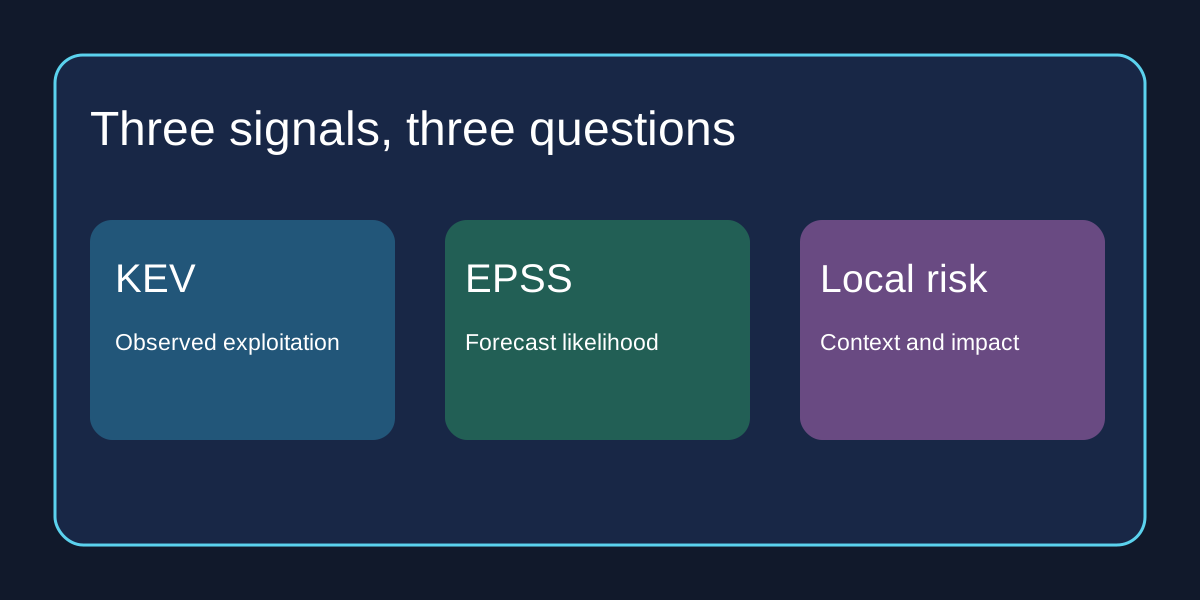
The U.S. Cybersecurity and Infrastructure Security Agency maintains the Known Exploited Vulnerabilities catalog, commonly called KEV. Inclusion depends on evidence that a vulnerability has been exploited in the wild and on available mitigation guidance. That signal is different from an academic proof of concept or a hypothetical severity estimate. A relevant KEV entry deserves immediate investigation because observed exploitation changes the risk discussion. However, a KEV listing does not prove that your own instance has been attacked, and a product that you do not use cannot create an exposure in your environment. Match the exact CVE and affected product versions before opening an urgent change ticket.
EPSS: a forecast that does not know your environment
FIRST's Exploit Prediction Scoring System estimates the probability that a published CVE will be exploited in the wild during the coming 30 days. It is updated daily and expresses a prediction, not confirmation of an incident. A higher EPSS score can help rank vulnerabilities that are not yet in KEV, but EPSS does not know whether your servers expose the affected service, whether compensating controls exist or what the compromised system is worth. FIRST explicitly warns that the score is not a complete organizational risk rating. If KEV shows confirmed exploitation but EPSS appears low, do not disregard the KEV evidence.
A five-column inventory you can build without buying software
Start with a basic spreadsheet containing the asset or application, software version, relevant CVE, exposure, and action owner. Record how the version was verified: administrator console, vendor inventory, package listing or managed device report. Avoid importing generic vulnerability feeds as if every CVE applies to every machine. Mark internet exposure separately from internal access. Add a simple yes/no for sensitive data or privileged access, and link each finding to the vendor advisory. Where the affected version is uncertain, mark the finding UNVERIFIED and assign a short discovery task rather than claiming remediation is complete. This small evidence table is more useful than an impressive-looking automated score with unknown provenance.
Step 1: validate that the vulnerable component really exists
Before assigning a critical incident priority, identify the installed version and the actual feature at risk. Some published flaws affect optional modules, only particular configurations or a narrow release range. Read the vendor's original security advisory alongside the CVE record. If the system is a cloud service, check whether the vendor already patched it and whether customer action remains necessary. If the service is behind another gateway, confirm whether the vulnerable code is still reachable. A scanner finding is a clue; it is not always a complete diagnosis. Keep a record of both positive and negative checks so the team can see why a finding was accepted or dismissed.
Step 2: combine evidence with local exposure
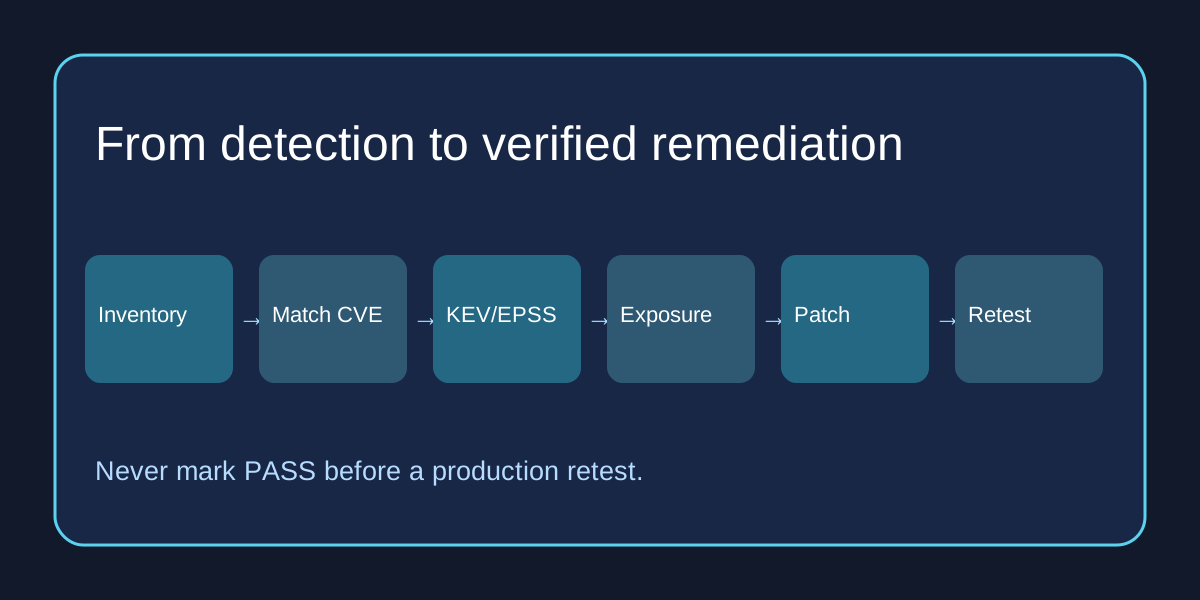
A workable triage sequence starts with known exploitation, then reachability, privilege and potential damage. A confirmed KEV vulnerability in an internet-facing identity system is not comparable to an unavailable feature in a powered-off lab device. Prioritize flaws that could allow remote code execution or authentication bypass on exposed systems that serve customers, hold credentials or enable administrative control. Do not interpret this as permission to postpone everything else indefinitely. Remaining findings still need owners, a maintenance calendar and periodic review. A lower initial priority is a scheduling decision, not proof that the system is safe.
Step 3: use EPSS to order the uncertain middle
For vulnerabilities not known to be actively exploited, consult the current EPSS probability and percentile as supporting evidence. The score is a forecast over a 30-day observation horizon, not a personalized percentage of your organization being hacked. Do not hard-code a universal cutoff and call everything underneath it safe. Instead, use EPSS to choose which otherwise comparable, relevant findings are examined first. Recheck a score when a major new advisory, exploit release or platform change occurs. Local business impact, compensating controls, legal obligations and recovery constraints can outweigh a population-level forecast.
Step 4: choose remediation rather than merely closing a ticket
Prefer vendor-supported security updates once compatibility and recovery plans are verified. When an update cannot be applied immediately, document a temporary mitigation supported by the vendor, such as disabling a vulnerable component, restricting access or applying a specific configuration change. Do not improvise firewall rules that lock out administrators or replace verified fixes with generic advice. Record the proposed change, the person who approved it, the rollback steps and the evidence needed to declare success. For high-risk systems, review whether prior compromise should be investigated rather than assuming that applying a patch erases what an attacker might already have done.
Step 5: test safely and preserve rollback
A preproduction check should confirm that the service starts, business-critical actions work and new security behavior is in effect. Keep configuration backups and version identifiers, not only a green dashboard. Apply the change in a controlled window when necessary, monitor errors, and be ready to revert if it breaks a production dependency. Remember that a rollback to a vulnerable version restores the risk: document the exception and compensating controls. An automated workflow can reduce manual effort, but it must not silently skip failed tests or report the patch as installed before the destination actually runs the corrected build.
Step 6: verify the result after deployment
Close the loop with a fresh version check against the target host and a repeat of the original detection. Confirm that the network path, application behavior and expected protections are still present. Keep a timestamp, host identifier, prechange evidence, postchange evidence and a reason for any exception. Where the vendor has a proof-of-fix test, run only the safe method it documents. Do not run exploit code against systems without authorization. If the patching platform reports success while the application still exposes the old component, the status remains PARTIAL until the discrepancy is resolved.
Common errors that distort patch priorities
The first mistake is treating CVSS, KEV and EPSS as interchangeable. CVSS describes severity characteristics, KEV documents known exploitation, and EPSS estimates future widespread exploitation. The second is skipping asset context: a vulnerable package in a disconnected test environment is not equivalent to a public-facing account service. The third is failing to distinguish detection from remediation. A fourth is losing sight of exceptions: teams should retain the reason a risk was accepted, who approved it and when it must be reconsidered. Finally, ignoring false positives can waste the same scarce resources needed for a genuine emergency.
A practical weekly routine for a small team
On Monday, refresh the asset list and compare relevant products with CISA KEV. On Tuesday, investigate unmatched or uncertain version reports. Midweek, group validated changes by service owner and maintenance window, using EPSS and business impact to order those without confirmed exploitation. Before the weekend, check that applied changes actually reached production, review failed jobs and capture rollback status. A serious newly exploited vulnerability should interrupt this routine; the weekly schedule is a baseline, not a reason to delay emergency work. The process can be run with vendor advisories, the free KEV catalog, FIRST's public EPSS material and an ordinary spreadsheet.
What this checklist does not establish
This guide does not claim that any vulnerability is present on your network, that every KEV entry requires the same deadline for every organization, or that EPSS can predict attacks on a specific machine. CISA's binding directives apply to the federal organizations they identify, not automatically to every private business. For your own environment, follow applicable law, contract requirements and vendor instructions. The defensible outcome is a verified list of relevant exposures and completed mitigations, accompanied by evidence. That outcome is measurable without inventing attack probabilities, vendor test results or compliance certificates.
Primary references and further reading
Review the CISA Known Exploited Vulnerabilities Catalog, CISA's risk-reduction guidance, the FIRST EPSS project and its FAQ explaining limitations. For adjacent GAMIC guides, see our ransomware first-hour response guide and passkeys explainer. Sources were reviewed for this evergreen guide; it is not reporting a new exploit or a new CISA listing on the publication date.