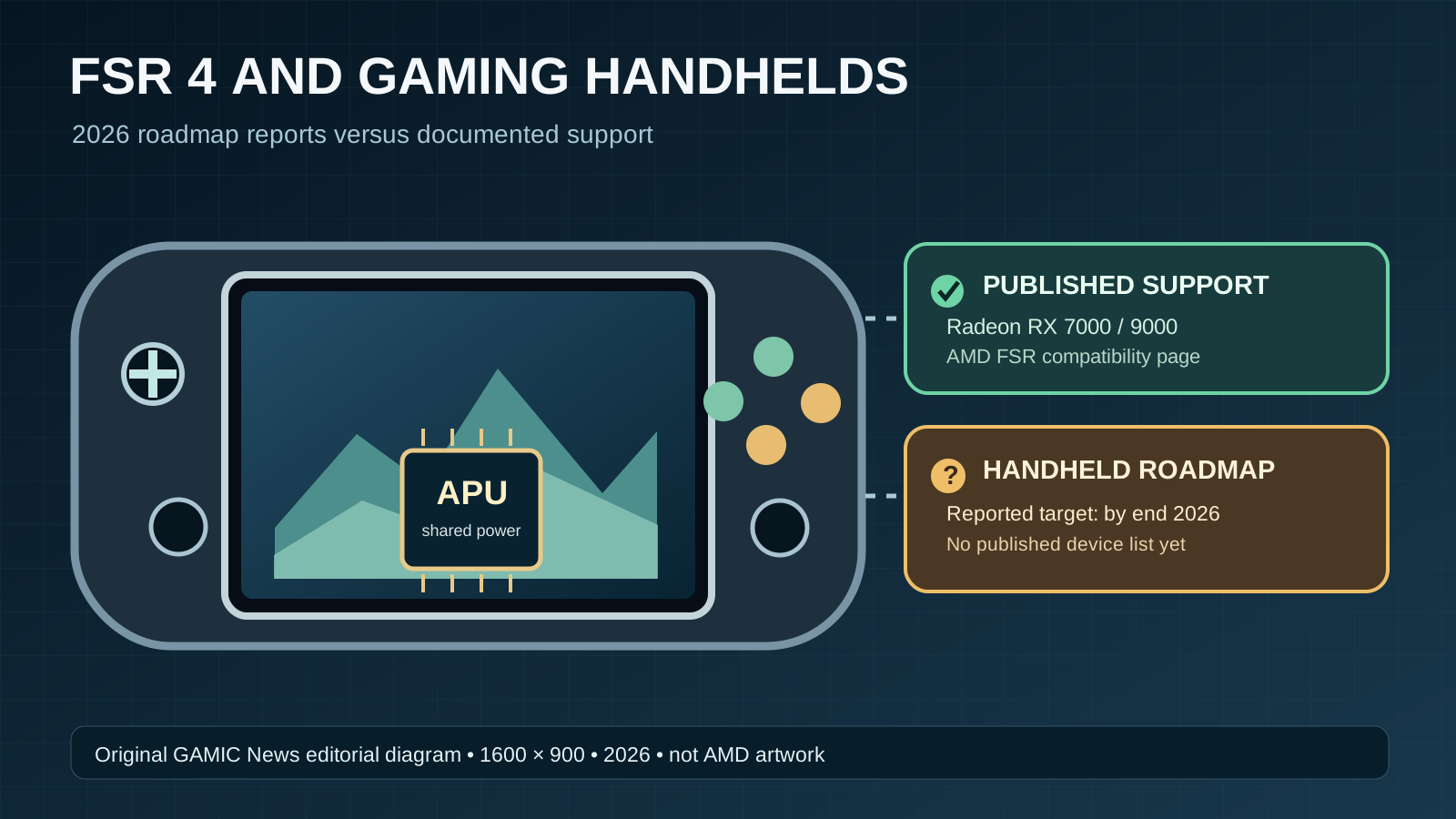

Reports published on October 8 and 9, 2026 say AMD intends to bring its machine-learning FSR 4 upscaling technology to more portable gaming hardware before the end of the year. The prospect matters to owners of gaming handhelds, compact PCs and laptops whose integrated graphics face tighter power and memory limits than desktop cards. But an executive's reported roadmap is not the same as a released driver or a supported-device list. Buyers need to separate the reported ambition from what AMD currently documents.
AMD's own FSR technology page currently lists machine-learning FSR Upscaling for Radeon RX 7000 and RX 9000 graphics cards, with RX 6000 support described for 2027. Its September 29 Adrenalin 26.9.2 release notes explicitly say that the downloadable package does not support handheld gaming devices and advise users to obtain device-specific drivers from their manufacturer. Those are primary-source statements about published support today; they do not necessarily contradict a future plan, but they limit what anyone can promise to a handheld owner now.
This article compares AMD's public compatibility documentation with independent coverage by The Verge and Windows Central of remarks attributed to computing and graphics executive Jack Huynh. We have not tested unreleased software or verified a private briefing recording. The resulting guide explains which claims are documented, which remain reported, why handheld power budgets change the engineering problem, and what evidence should appear before a player installs anything. It is an evidence-based news explainer, not a benchmark or an endorsement of unofficial modifications.
What AMD's official compatibility table actually says
AMD's FSR technology page describes FSR Upscaling, formerly called FSR 4, as a machine-learning reconstruction technique that builds a higher-resolution image from lower-resolution frames. The page differentiates it from older FSR versions and from frame generation. As checked for this report, the company says its ML-based FSR Upscaling is available on Radeon RX 7000 and RX 9000 graphics cards. The table is not a promise that every Ryzen handheld, laptop or integrated GPU can run the same implementation today.
For the closely related practical context, read Cloud Gaming Latency: Why Your Home Network Matters as Much as Internet Speed.
The published compatibility table is important because a technology family can span several algorithms with different hardware needs. FSR 1 and FSR 2 have broader stated compatibility than the latest machine-learning features, while some newer frame-generation and ray-related features have narrower requirements. A device that can select an option labeled FSR in a game's menu may be using a different version. The menu label alone cannot establish which model, driver path or graphics architecture is active.
What the October reports attribute to AMD's executive
The Verge reported on October 9 that AMD plans to bring FSR 4 to at least some gaming handhelds before 2027, and it noted unanswered questions about existing devices. Windows Central's October 8 coverage likewise attributes a year-end plan to Jack Huynh and discusses a lighter implementation intended for APUs. These accounts are independent journalism about reported remarks. They are relevant evidence of a direction AMD may take, but they do not substitute for a public compatibility matrix, downloadable package or formal product announcement.
That difference affects the headline a responsible publication should write. It is reasonable to say that AMD has been reported as targeting handheld expansion; it is not reasonable to say that every current handheld is already supported or that all owners will receive a free upgrade on a fixed date. Even the phrase before the end of 2026 describes a target window, not an individual device rollout. Vendor schedules can depend on silicon, software integration and manufacturers' testing.
Why an APU is not simply a smaller desktop graphics card
A handheld PC often uses an accelerated processing unit that combines CPU and graphics functions on one package. The graphics portion shares memory and a constrained power envelope with the rest of the system. Desktop graphics cards can have separate high-bandwidth memory and far more cooling capacity. Those differences matter when an upscaling model needs repeated inference operations while a game simultaneously renders, handles input and manages background work. An algorithm that looks excellent on a desktop card may require different optimization on a handheld.
A lighter model, if AMD delivers one, would therefore be an engineering compromise to evaluate rather than a guaranteed downgrade or guaranteed breakthrough. Smaller networks may reduce compute cost and latency, but quality depends on training, temporal stability, the game's motion vectors and how the implementation handles thin geometry. None of those outcomes can be inferred from the existence of a roadmap alone. A useful test must show both image quality and the real power cost on the actual device.
The driver problem: OEM support is part of the feature
AMD's official Adrenalin Edition 26.9.2 release notes contain a specific warning: the package downloaded from AMD does not include support for handheld gaming devices. AMD advises users to check with the original equipment manufacturer for device-specific drivers. This is not an obscure legal footnote. A handheld may depend on tailored controls, firmware, display behavior and power management. Replacing those components with a generic package can produce results that do not reflect a supported configuration.
For another relevant perspective, read Dragon's Dogma 2: Dark Arisen Launch Explained for Gaming Fans.
That is why a driver release and a feature demonstration are different milestones. A vendor can show an upscaling model running internally without offering a stable installation path to consumers. For an actual rollout, the device maker may need to validate a driver, publish release notes and specify which models receive it. Players should check the support page for their exact model and region. An internet post claiming that a desktop driver can be forced onto a handheld is not equivalent to vendor approval.
Existing handhelds versus future handheld designs
The most consequential unanswered question is backward compatibility. The Verge explicitly raised uncertainty over whether existing handhelds will be included or whether new hardware will be necessary. Windows Central describes a proposed lightweight model for APU-class devices, but the coverage does not supply a final public list of supported chips. Consumers should avoid treating broad phrases such as Ryzen handheld or RDNA graphics as precise compatibility guarantees. Products within a family can differ in architecture, firmware and available performance headroom.
A sensible reading of the reports leaves several possibilities open. Some existing devices might receive an OEM-approved update; others might be excluded because of hardware or performance constraints; future designs might ship with the feature from launch. The evidence available here does not resolve those possibilities. Anyone considering a purchase primarily for FSR 4 should wait for a model-specific compatibility statement instead of assuming a feature will arrive through an ordinary operating-system update.
FSR Upscaling is not the same thing as frame generation
Upscaling reconstructs an output image from a lower internal rendering resolution. Frame generation estimates additional frames between conventionally rendered ones. Both may change a performance counter, but they affect responsiveness and visual artifacts differently. AMD's official FSR page presents the capabilities as distinct elements within its wider Redstone family. An article that simply says FSR doubles frame rate without naming the method risks conflating two mechanisms and misleading players about how a game will feel.
On a handheld, responsiveness can matter more than a headline frame-per-second number. A generated frame does not necessarily reduce the time between an input and the game's next real simulation update. Upscaling, meanwhile, can lower rendering workload but may introduce shimmer or ghosting depending on implementation. Independent tests should measure frame times and latency as well as average frame rate, then inspect fine detail during motion. A still screenshot cannot settle those questions.
What a meaningful handheld benchmark must disclose
First, identify the exact handheld, processor, graphics driver, firmware version, operating system and game build. Then disclose resolution, graphics settings, FSR mode, power limit, whether frame generation is enabled and the method used to record results. A 15-watt test and a 30-watt test are not interchangeable. Nor is a plugged-in result automatically representative of battery play. Without these details, a claimed performance improvement cannot be reproduced and may be attributable to a different setting.
Second, report more than a single average. One-percent-low frame rates, frame-time consistency, input latency and power draw can reveal trade-offs hidden by a high average. Image-quality assessment should include motion, transparent effects, vegetation and fine interface text, not just static scenes. Finally, compare the proposed new implementation with the best supported option already available on that device. That comparison answers the reader's actual question: is the new path a useful upgrade under realistic constraints?
Why the published 300-game claim needs careful interpretation
AMD advertises machine-learning FSR support in more than 300 games on its technology page. That number describes a software ecosystem under the company's stated supported hardware conditions. It is not a verified list of 300 games that already run the same feature on every portable APU. Some games implement FSR natively, while others depend on driver-side options or specific integration versions. The compatibility of an individual title also depends on the hardware and software stack.
A practical game-by-game guide should therefore record three separate fields: whether the game supports the relevant FSR integration, whether the particular GPU and driver expose the machine-learning option, and whether the handheld maker supports that combination. Only when all three are verified can a player reasonably expect a repeatable setup. Copying a desktop game's compatibility badge into a handheld buying guide skips the most important part of the evidence.
What unofficial ports can and cannot establish
Enthusiasts sometimes experiment with alternate libraries, compatibility layers or leaked components to test whether a feature can run beyond its published support list. Such experiments can demonstrate technical curiosity and may inform future work. They do not prove that AMD will support the same configuration, that a game will remain stable, or that the result is legal to redistribute. We are not providing an installation recipe for unverified software because the provenance and safety of those packages can be unclear.
If a community video appears to show FSR 4 on a handheld, ask for the device details, software versions, capture method and repeatable before-and-after comparison. Watch for differences in frame generation settings or resolution that can distort conclusions. Even a genuine proof of concept leaves battery life, thermal behavior and ongoing maintenance unresolved. A vendor-backed release has a different burden: documentation, updates and a path for users to report problems.
What the 2026 timeline does and does not mean
The October coverage points to a year-end objective, while AMD's current public documentation still describes support chiefly in terms of discrete Radeon graphics cards. These statements can coexist if engineering and partner validation are underway but not finished. The responsible interpretation is conditional: the company may expand support, yet an announced target does not prove that a stable public download will be available for a particular model by December 31. An updated compatibility page would be stronger evidence than another unspecific interview summary.
The sequence worth watching is concrete. AMD could publish technical requirements for a lightweight APU model, then release developer guidance and a driver package, followed by OEM notices for specific handhelds. Game developers may also need to validate integrations. If any step slips, the timeline for an individual owner can move. GAMIC News will distinguish a reported roadmap from those later release milestones rather than silently converting the former into a completed product.
How to decide whether to buy a handheld now
If a handheld already meets your needs with its current supported graphics features, this report provides no reason to discard it. Evaluate the device you can buy today: sustained performance in games you actually play, battery life, screen readability, controls, storage and repair options. Future FSR support may become a bonus, but it should not be the deciding factor until the manufacturer confirms it for the exact model. An attractive promotional demonstration cannot replace an enforceable return policy or reliable warranty.
If your main interest is machine-learning upscaling, compare products against AMD's present compatibility documentation and independently measured results. Ask retailers and manufacturers for written model-specific confirmation, not a general reference to Radeon branding. Where confirmation is absent, label the feature as unverified. That approach is less exciting than a universal upgrade promise, but it protects readers from paying today for a feature that may remain limited, delayed or dependent on hardware they do not own.
What evidence would change this assessment
The clearest update would be a dated AMD compatibility table naming APU generations or products, accompanied by driver release notes and OEM download pages. Independent reviewers could then test the same game on a supported handheld before and after the update under identical power and graphics settings. That combination would support stronger claims about availability, image quality and battery trade-offs. A private presentation slide or a social-media quotation alone would not establish those outcomes.
For now, the evidence supports two separate conclusions: AMD publicly documents ML-based FSR Upscaling for specified Radeon graphics cards, and reputable independent outlets report a plan to expand the technology to portable hardware. The gap between those facts is the story. Until a release bridges it, readers should treat handheld compatibility as pending rather than confirmed. For related gaming hardware context, see GAMIC News's AI PC buyers guide and its coverage of local AI laptop memory constraints; both explain why silicon and memory budgets affect real-world software claims.